
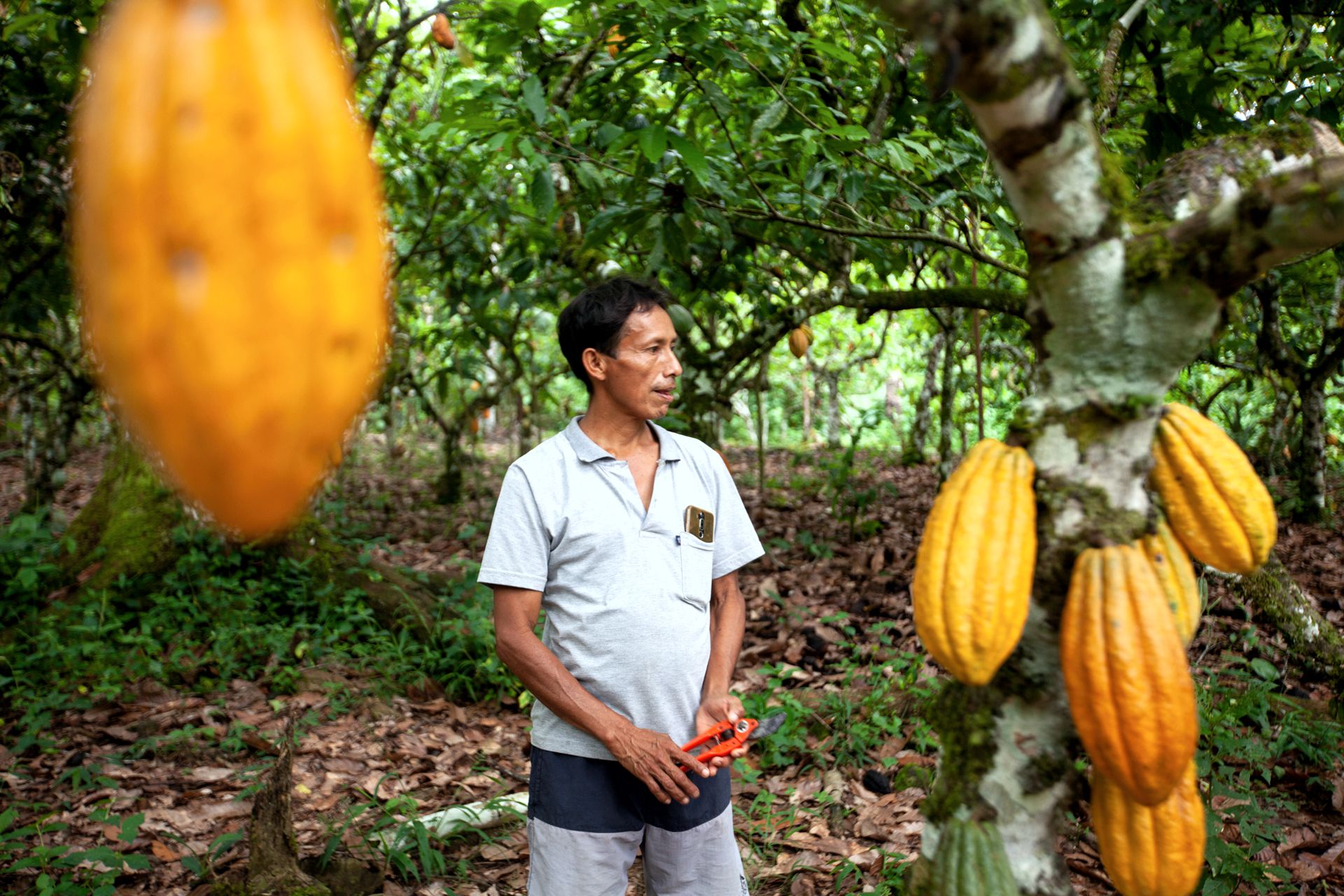
Between 70 and 100% of the total export of cocoa from countries such as Bolivia, Colombia, Costa Rica, Ecuador, Peru and Mexico corresponds to these special varieties of cocoa. In the face of the challenge of designing an intelligence mechanism to develop the market for fine and aroma cocoa, CAF and Minagri launch the Observatory of the Latin American Cacao Initiative (ILAC).
Latin America is the main production region of the "prime" varieties of cocoa internationally, with about 80% of world production, mainly due to their genetic diversity.
According to data from the International Cocoa Organization (ICCO), between 70 and 100% of the total export of cocoa from countries such as Bolivia, Colombia, Costa Rica, Ecuador, Peru and Mexico corresponds to these special varieties of cocoa. However, there are important challenges in consolidating a competitive position of the region in this promising segment of the market.
This was revealed by Eleonora Silva Pardo, director representative of CAF in Peru, and Jaime Solomon, Deputy Minister of Agricultural and Irrigation Development and Infrastructure, at the launch of the Observatory of the Latin American Cocoa Initiative (ILAC))in the framework of the "International Symposium on Cocoa Research," which takes place from 13 to 17 November and brings together more than 500 participants, mainly delegations that will represent the world's cocoa-producing powers such as Ghana, Brazil, Côte d'Ivoire, Mexico, among others.
Silva Pardo recalled that in 2016 CAF promoted the Latin American Cocoa Initiative (ILAC), in order to promote the development of cocoa as a sustainable economic activity and an integrative element of the peoples that have used it in the region and currently formed by: Peru, Bolivia, Brazil, Colombia, Costa Rica, Ecuador, the Dominican Republic and Panama.
After referring to the fact that 90% of cocoa production is based on low-scale family activities of less than five hectares, the director of CAF detailed that in those countries about 1.7 million hectares are grown, and indicated that exports to markets in Europe and the United States, mainly, are about 745 TM and equivalent to about USD 985 million.
"Cacao cultivation directly benefits 329,607 producers, but indirectly promotes economic inclusion and improves the living standards of more than three million Latin Americans. With the growth of demand for Latin American prime cocoa, well above the average of standard cocoa that is marketed in the form of commodities, the development of value chains associated with fine cocoa is a challenge and offers an opportunity for the region's producing countries," said the director of CAF in Peru.
For its part, Solomon said that the Ministry of Agriculture (MINAGRI) as president of the Forum of the Latin American Cocoa Initiative for the period 2012 - 2018, together with the Biodiversity Programme of the Green Business Unit of CAF, had the idea of promoting the ILAC Observatory, as a market intelligence mechanism, which provides useful information for the development of the market for fine and aroma cocoa.
"The Observatory shall systematize macro and microeconomic information and statistical data. In addition, it will analyse relevant news supporting decision-making by authorities, institutions, entrepreneurs, associations, producer associations, allies and other stakeholders in order to contribute to the competitiveness of the fine cocoa sector in our region," he added.
He also stated that the challenge from supply is to identify, maintain and expand the genetic base that represents the main regional comparative advantage. While from the demand perspective, there is a need to harmonize the processes of identification, tasting and classification of cocoa, on the perspective of flavors and aroma.
At another time, while referring to the fact that Peru has six large cocoa regions that account for 90% of national production, Solomon estimated that national production will grow this year between 9% and 10% and stressed that much of the fine cocoa of aroma is concentrated in the national territory with characteristics that differ it from the rest of the world and that it is paid between USD 2,000 and USD 8,000 a ton in international markets of Europe and the United States.
"Work is currently being done to generate a better supply for Peruvian fine cocoa, but also to search for international markets; for this we have been doing a coordinated work between the Ministry of Agriculture and Irrigation, the Ministry of Foreign Trade and the Agency for the Promotion of Exports," he concluded.
Source: CAF